Classes 6–10
Discuss class suitability and the student’s learning goals with the academy before applying.
One-to-one mentoring / Complete guide
Aspire. Inspire. Master.
AIM combines personalised mentoring, hands-on practice and a structured learning roadmap. It helps the learner connect reading, awareness, reasoning and communication rather than treating each as a separate skill.

The simple explanation
AIM combines personalised mentoring, hands-on practice and a structured learning roadmap. It helps the learner connect reading, awareness, reasoning and communication rather than treating each as a separate skill.
Discuss class suitability and the student’s learning goals with the academy before applying.
Individual mentoring, a structured roadmap and hands-on practice.
Awareness, reasoning, communication and consistent learning habits.
The learning focus
Simple explanations of the approach, without an invented syllabus, timetable or outcome guarantee.
Begin with the student’s interests, learning context and goals. Individual guidance creates space for questions and a more focused direction.
A roadmap brings the learning-focus areas together. It provides direction without implying a fixed month-by-month timetable or a guaranteed result.
Guided practice gives students opportunities to use what they read, connect ideas and express their understanding.
Foundational reading and NCERT references support subject understanding. Newspaper-based learning builds a connection with current events and everyday awareness.
Maps help learners explore places and context. The focus is making connections, not memorising isolated facts.
Purposeful activities support thoughtful questions, clearer expression, disciplined learning and responsible thinking.
The approach
Personal attention connects the learner’s questions with practical direction.
These steps explain the approach. They are not a fixed programme timetable.
Speak with the academy about the child’s class, interests and learning goals.
Discuss how individual guidance and the learning-focus areas will support the student.
Explore reading, newspapers, maps and guided learning activities.
Encourage thoughtful participation and useful habits over time.
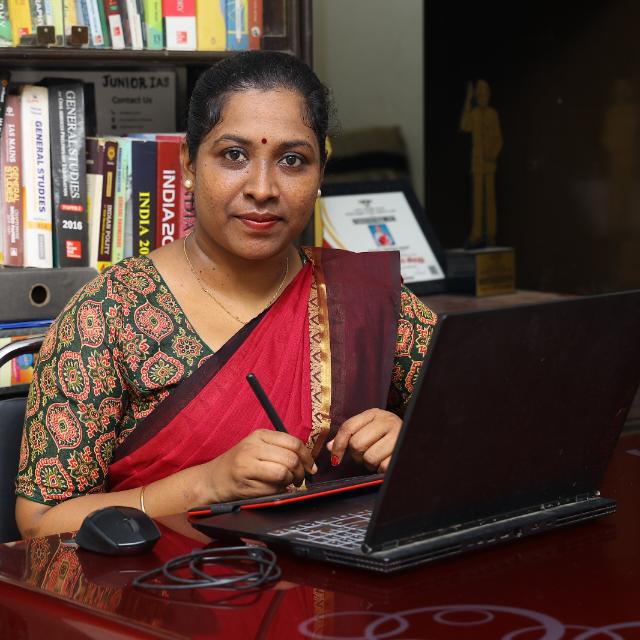
The mentor behind the learning
IAS Mentor · UPSC Educator · Career Counsellor
Guiding civil services aspirants since 2013, with subject expertise in Geology, Geography, Polity, Economy and CSAT. Her mentoring approach focuses on clear explanations, individual learning needs and practical direction.
A university rank holder in B.Sc. and M.Sc. Geology. Doctoral research was undertaken in Groundwater and Remote Sensing; the thesis has not been submitted.
Explore her professional profileBefore the next step
Discuss the child’s class, interests, current learning context and goals with the academy. This guide offers information, not an automated eligibility or admission decision.
Confirm delivery arrangements, current availability, session timings, frequency, duration and any applicable fees directly with the academy. These details have not been assumed in this guide.
AIM is personalised one-to-one mentoring. LEAP is Sunday group learning. Paruvathe Payir Sei is a separate introductory webinar about early foundations and parental guidance.
No. The focus is foundational learning and mentoring. No selection, appointment, examination result or fixed academic outcome is guaranteed.
Start with a WhatsApp or telephone conversation. If applying for admission, discuss requirements with the academy. For a learner under 18, a parent or guardian should provide the contact details and consent.