An opportunity to understand India's five citizenship routes, general naturalisation requirements and the CAA, with dated notes linking to official Indian and UK sources.
Read the complete guide ↗
Citizenship & Awareness / Learning guide
JUST AN OPPORTUNITY TO UNDERSTAND OUR OWN CITIZENSHIP LAWS! 🇮🇳
Junior IAS Academy · 5 min read
Academy perspective · Supplied article reproduced in full. Dated editorial notes and official sources are provided separately for context.
The UK's recent proposal to increase the standard permanent residency (ILR) qualifying period from 5 years to 10 years has sparked quite a debate among Indians living there.
But let's look at this from another perspective.
Before debating another country's immigration policies, let's understand what it takes for a foreign national to become an Indian citizen.
Under India's Citizenship Act, 1955, there are five routes to citizenship:
By Birth – Depending on the date of birth and parents' citizenship status.
By Descent – Through an Indian parent when born outside India, subject to applicable conditions.
By Registration – For specific eligible categories, including certain spouses of Indian citizens and persons of Indian origin.
By Naturalisation – For eligible foreign nationals who wish to become Indian citizens.
By Incorporation of Territory – When a territory becomes part of India.
Now, here's what we really need to understand. If a foreigner wants to become an Indian citizen through naturalisation, what are the requirements?
Under the general naturalisation provisions, the applicant must:
Have lived in India for 12 months immediately before applying.
Have lived in India for at least 11 years in aggregate during the preceding 14 years.
Be of good character.
Have adequate knowledge of a language listed in the Eighth Schedule of the Indian Constitution.
Intend to reside in India or serve an eligible Indian institution.
Fulfil the other conditions prescribed under the Citizenship Act.
There is also a special provision under the Citizenship (Amendment) Act, 2019 (CAA), for eligible migrants belonging to six specified religious communities from Afghanistan, Bangladesh and Pakistan who entered India on or before 31 December 2014. Their qualifying residence requirement for naturalisation is reduced to five years, subject to the applicable conditions.
THE POINT IS SIMPLE.
Every country has its own rules, conditions and eligibility criteria for granting citizenship. We can debate policies, agree or disagree with them, but understanding our own country's laws is equally important.
Instead of just reacting to the news, let's use it as an opportunity to learn.
Knowledge is always an opportunity! 🇮🇳
Official sources · Checked 5 November 2026
Read the detail behind the idea.
General naturalisation
The Third Schedule, clauses (c) and (d), separates the immediate 12 months from the 11 years in aggregate within the 14 years before that 12-month period. Qualifying government service can also count, and specified relaxations exist.
What the CAA’s five years means
The five-year figure replaces the 11-year aggregate condition in clause (d); the separate 12-month condition remains, subject to permitted relaxations. It is not an automatic grant after five years. The six communities are Hindu, Sikh, Buddhist, Jain, Parsi and Christian. Other statutory eligibility conditions and territorial exclusions apply.
Help school students disagree respectfully: listen first, explain a reason, ask a better question and practise with a short activity at home or in class.
Read the complete guide ↗
Communication / Learning guide
How Students Can Disagree Without Arguing
Junior IAS Academy · 8 min read
Academy learning journal · Originally published on LinkedIn. The complete guide is available below without leaving this website.
A strong opinion is only the beginning
One student thinks the class outing should visit a museum. Another wants a nature park. Both have reasons. Within a minute, however, the discussion becomes a contest over who can speak louder. The class has plenty of enthusiasm and very little progress.
Disagreement is an ordinary part of learning. Students will meet it in group projects, classroom discussions, friendships and family decisions. The useful skill is to explain a view clearly, understand another person's reasoning and keep the conversation workable when the answer is not obvious.
For parents and teachers supporting school students in Chennai and across Tamil Nadu, small everyday discussions offer a place to practise. The goal is not a child who agrees with everyone. It is a child who can think, listen, question and speak with respect.
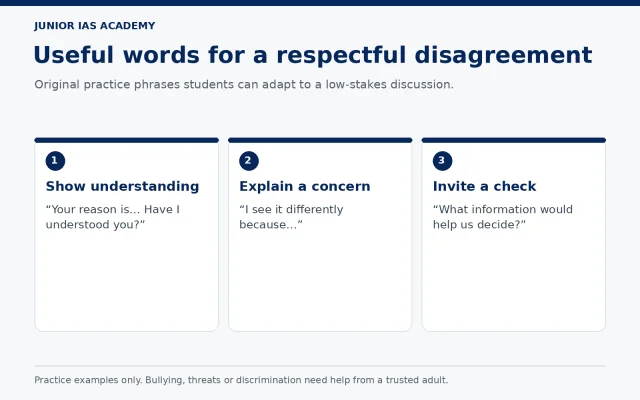
A useful sentence to practise: “I understand your reason. I see it differently because…”
Keep the idea separate from the person
“That plan may take too much time” addresses a proposal. “You always have bad ideas” attacks a person. The first gives the group something to examine. The second makes it harder for anyone to listen.
Ask students to name the exact point they disagree with. Is it the cost, the evidence, the timing or the expected result? A specific disagreement can become a useful question. A label about someone's intelligence or character usually closes the conversation.
Adults can model this distinction without making a speech. When a child proposes something impractical, explain the constraint and invite another approach. The child hears how a person can take an idea seriously while still deciding that it needs to change.
Explain the other view before answering it
Listening becomes easier to notice when it produces a brief, fair explanation. Ask a student to summarise the other person's reason and check whether the summary is accurate. This is a listening exercise, not a requirement to agree.
For example: “You prefer the museum because you think we can connect the visit to our history lesson. Have I understood you?” The other student can correct the summary before the discussion moves on.
UNICEF's communication guidance encourages active listening and checking understanding with children. In a school discussion, the same broad principle helps adults and students avoid answering a point that nobody actually made. Keep the practice brief so it feels like a conversation rather than a test.
Give the opinion a reason
A reason explains why a person holds a view. Evidence helps someone assess whether that reason is supported. Students need opportunities to distinguish both from simply repeating the opinion with more confidence.
Compare “The park is better because it is better” with “The park may suit our science topic because we are studying local plants.” The second sentence creates a question the group can investigate: does the proposed visit actually support that learning goal?
Encourage students to identify the source of a factual claim. A school notice, an official visitor-information page and a classmate's memory provide different kinds of support. If the fact has not been checked, a student can say so. Honest uncertainty is a useful part of reasoning.
Ask a question that opens the discussion
Some questions are invitations. Others are accusations wearing a question mark. “How would your plan fit within the available time?” invites an explanation. “Do you even understand the timetable?” puts the other person on the defensive.
Practise questions about the proposal: what information is missing, which difficulty matters most, and what would make the option more workable? Give the speaker time to answer before asking the next question.
A student does not have to produce a clever challenge every time. A simple request such as “Can you explain that example?” can move the discussion further than a dramatic objection prepared while the other person was speaking.
Notice that there may be more than two viewpoints
A debate can become stuck when students assume the class has only two camps. A third student may care about accessibility. Another may be worried about travel time. Someone else may want to understand how the outing connects to the current lesson.
Harvard Project Zero's work on perspective-taking highlights that people can have different connections to the same topic. Students can explore that general idea by asking whose experience or concern the discussion has not yet considered.
Do not ask a student to speak for an entire community or guess another person's private circumstances. Invite people to describe their own relevant needs, and let the responsible adults handle sensitive information appropriately.
Use a small fictional example
Return to the museum and nature-park discussion. This is an invented classroom scenario, not a reported Junior IAS Academy session. The teacher first asks the group to agree on the decision it needs to make and the constraints it must respect.
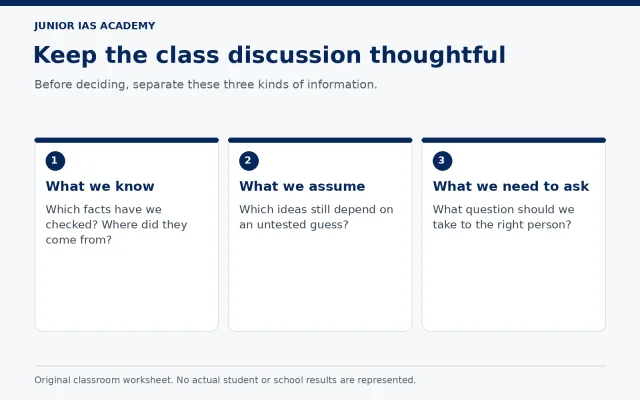
The students identify learning relevance, available time, cost and the needs of the group. They separate confirmed information from assumptions. The museum supporter acknowledges that the park could support a science discussion. The park supporter recognises the connection between the museum and the history lesson.
They still disagree. That is acceptable. Each student now understands more about the other proposal and can explain the remaining difference. The teacher can guide a decision using the agreed criteria rather than rewarding the loudest speaker.
The valuable learning is in the discussion as well as the choice: students practise explaining, checking, revising and accepting that a group decision may differ from their first preference.
Make changing your mind an ordinary option
Children can feel that revising a view means losing. Adults can help by showing what a thoughtful change sounds like: “I had not considered that travel time. With that information, I would adjust my plan.”
Invite students to name what could change their view. A different fact, a clearer explanation or a constraint they had missed may matter. This question helps distinguish a conclusion based on reasons from a position that must be defended regardless of the evidence.
Changing one's mind is not always required. A student may understand the other view and still reasonably disagree. The important habit is to give reasons that respond to the discussion instead of simply repeating the opening sentence.
Give quiet students a way in
A fast discussion can reward speed rather than thought. Offer a short pause to write a reason or a question before speaking. A student who needs more time can then enter with something prepared.
Small pairs may feel easier than a whole-class debate. Where appropriate, students can begin in a language they use comfortably and then work on expressing the same reasoning in the classroom language. Language practice and the quality of an idea deserve separate attention.
A facilitator can also check who has not had a turn. Avoid making a quiet student perform unexpectedly in front of the group. Provide a clear invitation and a manageable way to contribute.
Pause when the conversation becomes too heated
If people are interrupting, mocking or raising their voices, the next step may be a pause rather than another argument. Agree a simple way to stop, settle and return to the specific issue when the group is ready.
Adults should not describe bullying, threats or discriminatory remarks as an ordinary debate that children must solve alone. A student should be able to seek help from a trusted teacher or caregiver. Respectful discussion requires an environment where people can participate safely.
UNICEF India's guidance for caregivers of adolescents encourages open communication and handling disagreements without aggression. Adults can demonstrate this approach through their own tone, turn-taking and willingness to repair an unfair remark.
A ten-minute practice for home or a learning group
Choose a low-stakes question with more than one reasonable answer, such as how to organise a small reading corner. Give each person a minute to prepare one preference and two reasons. Then invite them to explain the other view before presenting their response.
Ask one open question each. Finish by identifying an agreed point, a remaining difference and any fact that needs checking. Keep the outcome small enough to complete without an extended competition over who won.
Afterwards, reflect on the process. Was the other view described fairly? Did anyone ask a useful question? Did new information change the discussion? These observations give students something practical to try next time.
What parents can look for in a programme
When exploring a school-student learning programme, ask how mentors support discussion. Are students encouraged to explain their reasons? How are quieter participants included? What happens when a confident answer is unsupported or a disagreement becomes personal?
Junior IAS Academy is a place for parents to discuss the current programmes available for their children. Ask about the actual activities, feedback and age suitability. Reasoning and communication should be visible in the learning experience, with room for students to ask questions and improve over time.
A student sees a colourful chart and immediately announces the winner. Another student pauses: What is being counted? Over what period? Out of how many people? That second response is the habit worth ...
Read the complete guide ↗
Data literacy / Learning guide
How to Read Charts and Percentages: A Data-Literacy Guide for School Students
Junior IAS Academy · 10 min read
Academy learning journal · Originally published on LinkedIn. The complete guide is available below without leaving this website.
Start with the question, not the tallest bar
A student sees a colourful chart and immediately announces the winner. Another student pauses: What is being counted? Over what period? Out of how many people? That second response is the habit worth practising. Reading charts well means understanding both the numbers and the story those numbers can reasonably support.
Data literacy for school students starts with a few manageable skills: reading labels, checking scales, comparing like with like and describing uncertainty. You do not need a complex spreadsheet to begin. A notebook, a small set of numbers and a willingness to ask questions are enough. This guide uses invented classroom examples throughout, not results from an actual school or academy.
Parents can use the activities at home, and students can try them with a teacher. Keep the discussion curious rather than competitive. The aim is to explain an answer clearly, including what the evidence does not tell us.
Key takeaways
Read the title, units, dates and source before comparing values. Ask “out of how many?” when you see a percentage. Distinguish percentage points from relative percentage change. Describe who answered a survey, and separate the pattern you observe from the explanation you would like to test.
1. Read the whole chart before interpreting it
Give every chart a short first inspection. Read its title, both axes, the unit, the dates and the source. Then look for a note explaining who or what was included. A graph labelled “Library use” could show books borrowed, people visiting, or hours spent inside. Those are different measurements and cannot be substituted for one another.
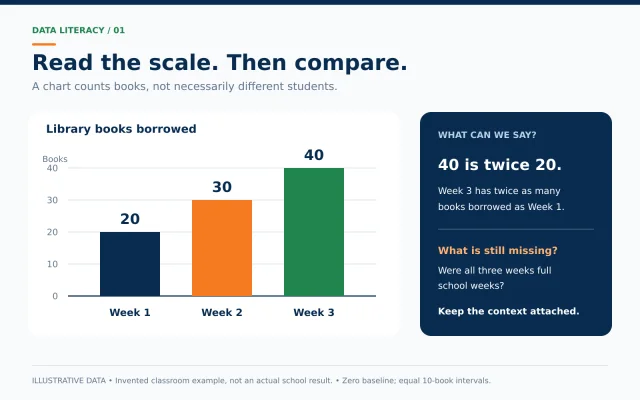
Imagine three weekly borrowing totals: 20 books in Week 1, 30 in Week 2 and 40 in Week 3. We can say that the recorded total increased each week. We cannot say that 40 different students borrowed books in Week 3. One person could have borrowed several books. A useful student answer would name the measure directly: “Forty books were borrowed,” rather than “Forty students used the library.”
Now ask about the time period. Were all three weeks full school weeks? If one included a holiday, that difference may matter. You do not have to reject the chart. You simply need to keep its context attached to your conclusion.
2. Read the axes, not just the visual impression
A bar chart communicates quantities through bar length. The Office for National Statistics recommends a zero starting point for bar-chart value axes. Without it, a modest difference can look much larger. When reading a chart, follow the numbered scale rather than judging the picture alone.
Try this with our illustrative library totals. On a scale from zero to 40, the final bar is twice as long as the first because 40 is twice 20. If somebody crops away the bottom of the chart, the visible bars can suggest a very different relationship. The printed values have not changed, but the visual impression has.
Check the gaps between tick marks too. A scale marked 0, 10, 20 and 30 uses equal steps. An unlabeled jump or a change of units needs attention. For line charts, a non-zero axis can sometimes be appropriate, so do not apply a blanket rule that every shortened scale is wrong. Read the actual values and the purpose of the chart.
Illustrative bar chart showing 20, 30 and 40 library books borrowed across three weeks.
3. Ask “out of how many?” whenever you see a percentage
Percent means out of one hundred. To find a percentage, divide the part by the total and multiply by 100. If 12 of 30 students choose a reading club, the share is 40%. If 12 of 60 choose it, the share is 20%. The same count tells a different story when the group size changes.
Here is another invented comparison. Class A has 30 students and 15 choose badminton. Class B has 40 students and 16 choose badminton. Class B has more badminton choices by count, but Class A has the higher share: 50% compared with 40%. Neither statement contradicts the other. Each answers a different question.
When someone says a result is “higher,” ask whether they mean a larger number or a larger proportion. Then write the comparison in full. “Class B has one more badminton choice” is precise. “Class B likes badminton more” is too broad for this small exercise.
4. Separate percent change from percentage-point change
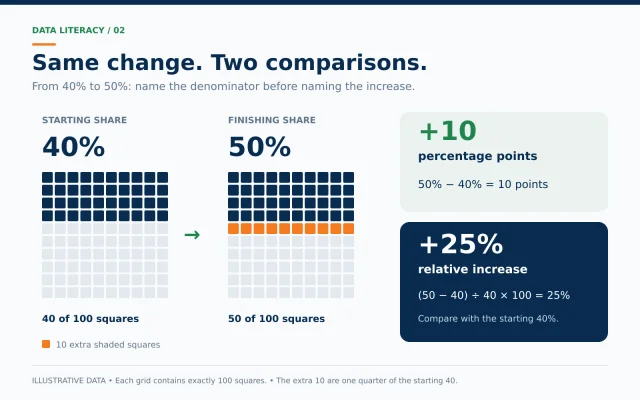
Suppose the share choosing a reading club rises from 40% to 50%. The difference is 10 percentage points. The relative percentage increase is 25%, because the increase of 10 is one quarter of the starting value of 40. These are two ways of describing the same change, with different denominators.
A hundred-square grid makes the distinction visible. Shade 40 squares in the first grid and 50 in the second. There are ten extra shaded squares out of the full hundred. Compared with the original forty shaded squares, those ten extra squares represent a quarter more. Always state which comparison you are making.
For a school exercise, write three separate lines: starting share 40%; finishing share 50%; change 10 percentage points, equivalent to a 25% relative increase. There is no need to rush the calculation. Naming the starting value is often the step that prevents confusion.
Two hundred-cell grids distinguish a ten-percentage-point rise from a twenty-five-percent relative increase.
5. Match the chart to the question
Bar charts are useful for comparing categories, such as the number of votes for different clubs. Line charts can help show change over time. Pie charts show parts of one whole, so the categories must fit that purpose. The ONS advises against pie charts for questions where respondents may select several answers, because the total can exceed 100%.
Imagine asking students which activities they enjoy and allowing three selections each. Reading, football and music are no longer separate slices of one exclusive choice. A bar chart showing the number selecting each activity would be easier to interpret. Include a note that multiple answers were allowed.
Before drawing, finish this sentence: “I want the reader to compare…” If you cannot finish it clearly, return to the question. Decorative colours and three-dimensional effects cannot repair an unclear comparison. A simple chart with honest labels is a better starting point.
6. Look for the missing people and missing answers
A survey of your friends tells you about the people who answered it. It does not automatically describe your whole school. If you ask only members of a football club which sport they enjoy, football will probably be well represented. That is a reason to describe the group accurately, not a reason to hide the result.
Write down how many people were invited and how many replied. If 20 classmates are invited and 12 reply, the eight missing responses may matter. Avoid silently treating them as votes against every option. “Six of twelve respondents chose music” is different from “Half the class chose music.”
The same care applies to online polls. A large response count does not, by itself, prove that the group represents everybody. Ask who could participate, who chose to respond and whether the question encouraged a particular answer. These questions help you decide how far a conclusion can travel.
7. Describe a pattern without inventing a cause
In our imaginary library, borrowing rises during the same month that a reading poster appears. It is tempting to credit the poster. But the school might also have acquired new books, introduced a reading period or changed its borrowing rules. The chart alone cannot separate those explanations.
A careful sentence would be: “Borrowing increased during the period when the poster was displayed.” A stronger claim, such as “The poster caused borrowing to double,” requires more evidence. This is a useful distinction for school projects, advertisements and everyday conversations about results.
Try dividing a page into two columns: “What the data show” and “Possible explanations to investigate.” Put the numerical pattern in the first and your ideas in the second. That small separation keeps an interesting hypothesis from becoming an unsupported fact.
8. Try a small survey with a clear boundary
Choose a low-stakes question, such as which of three fictional story settings a small group prefers. Explain that participation is optional. Avoid collecting names, phone numbers, marks, family income or health information. You need only anonymous counts for this exercise. Ask a parent or teacher before involving classmates or sharing results.
Keep the question neutral and the response choices clear. Allow one answer if you want categories that add up to one total. Record the date, group size and exact question. Count the responses, check the sum and make a simple bar chart with a zero baseline. This is an original practice activity, not an academy assessment.
NCERT’s Grade 8 mathematics bridge programme includes collecting data and representing it through tables and charts. Your own exercise can follow that practical spirit without becoming a large research project. End with two accurate observations and one limitation.
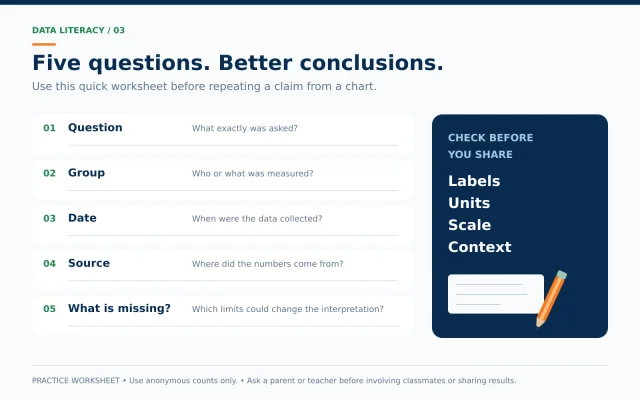
Five-question worksheet for checking the context behind a chart.
Quick questions students often ask
Does a bigger sample always give a better answer? More responses can be useful, but the way people are selected still matters. Asking more members of the same sports club does not turn the result into a survey of the whole town. Describe the selection method as carefully as the size.
Can a chart be accurate but incomplete? Yes. The plotted numbers may be correct while the title leaves out the date, the source is missing or the chosen period excludes an important earlier change. Look for the fuller explanation before deciding what the picture means.
What should I do if two charts disagree? First compare their definitions, dates, locations and units. One may show totals and the other percentages. One may cover a school term and the other a calendar year. Only after checking those details can you tell whether there is a genuine disagreement.
Do I need to calculate everything mentally? No. Use paper or a calculator, then check whether the result makes sense. An estimate is helpful: if 15 of 30 students select an option, the answer should be half, so 50% is reasonable.
9. Use a five-question checking routine
Before repeating a claim from a chart, ask: What question was asked? Which group was measured? When were the data collected? Where did the numbers come from? What information is missing? Write these five prompts on a page and reuse them. They are especially helpful when a screenshot has lost its caption or source.
Parents can model the same habit without turning dinner into an examination. Pick one chart, ask one question and listen to the explanation. If a calculation is wrong, return to the numbers together. If the conclusion is too broad, ask what smaller statement the evidence supports. You can praise careful reasoning without pretending every answer is correct.
The next time a bold percentage catches your eye, pause before agreeing or disagreeing. Find the whole behind the percentage, read the scale and name the limits. These small habits make a student’s explanations clearer and make numerical claims easier to discuss fairly.
Save the five-question routine and try it with one chart this week. Which label or missing detail changed your first impression?
A map becomes useful when you can explain what it shows, work out where you are and judge how far you need to travel. Start with the title, legend, direction and scale. Then use landmarks or coordinat...
Read the complete guide ↗
Geography / Learning guide
Map Reading for Students: Directions, Scale and Coordinates Explained with Simple Activities
Junior IAS Academy · 10 min read
Academy learning journal · Originally published on LinkedIn. The complete guide is available below without leaving this website.
A map becomes useful when you can explain what it shows, work out where you are and judge how far you need to travel. Start with the title, legend, direction and scale. Then use landmarks or coordinates to locate a place. These small checks turn a page of shapes into information you can use.
Picture a school excursion. One student points to a museum and says, “It is just here.” Another asks, “Which entrance? How far from the bus stop? Is that line a road or a railway?” The second student is already thinking like a map reader.
This guide is for students in Classes 6–10 and the parents and teachers who support them. You do not need expensive equipment: a pencil, ruler, notebook and suitable printed map are enough. The aim is to understand places, rather than memorise a page of labels.
Start by asking what the map is for
Before looking for your destination, read the title. A rainfall map, a railway diagram and a street map may cover the same area while answering very different questions. A map showing state boundaries will not necessarily tell you which road to take. A transport diagram may simplify distances so that connections are easier to see.
Ask three questions: What area does this cover? What information does it emphasise? What information does it leave out? Look for a date or edition too. An old road map can still teach direction, but it may not show a recently opened bridge.
Try this at home. Find two maps of the same city. Write one question each map can answer well. Then write a question neither can answer. This is a useful reminder that a map is a carefully selected representation, not the place itself.
A useful map question is: “What does this help me understand—and what must I check elsewhere?”
This is an editorial learning prompt, not a quotation attributed to a public figure.
Read the legend before interpreting the symbols
The legend, sometimes called a key, explains what symbols, colours and lines mean. A blue shape may represent water on one map; on a statistical map, blue could represent a population category. Never assume that a colour has the same meaning everywhere.
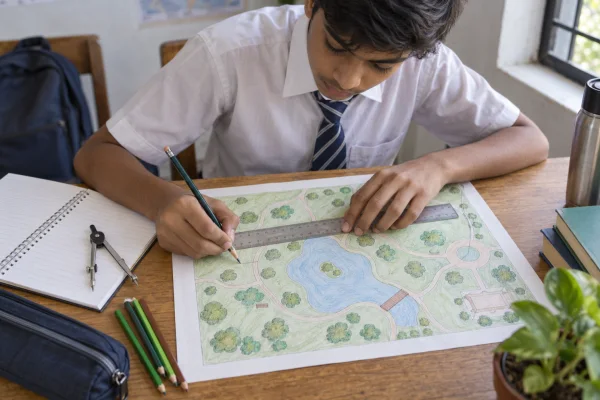
For a practice activity, draw a fictional park. Choose symbols for a gate, toilet, drinking-water point, pond and path. Add a legend. Give the sheet to someone who has not watched you draw it. Can they find the toilet without asking you?
If they cannot, revise the symbol or explanation. The purpose is communication. A beautiful drawing that leaves its reader guessing needs more work.
Keep symbols large enough to distinguish and avoid relying on colour alone. Different shapes or line styles help when a map is printed in black and white, or when a reader finds some colours difficult to distinguish.
Conceptual illustration: practising with a fictional map. The pictured drawing is not a navigational map or a scale-measurement exercise.
Directions belong to the map, not to your body
North, south, east and west are the four cardinal directions. Read the north arrow or orientation information before deciding that the top of a page is north. Many maps use north at the top, but not all do. A phone map may rotate as its user moves.
Put a north arrow on your fictional park map. If the pond is east of the gate, turning your paper does not change that geographic relationship. Your own left and right change when you turn; the map’s directions stay tied to its orientation.
Now practise giving an instruction with a starting point: “From the gate, the pond lies northeast.” Compare it with “The pond is over there.” The first statement gives another person enough information to begin checking the claim.
For younger learners, use four directions first. Add northeast, southeast, southwest and northwest when those relationships feel comfortable. Precision develops through practice, not by introducing every term at once.
Scale: turn a paper distance into a real distance
Scale describes the relationship between a distance on the map and the corresponding ground distance. It may appear as a written statement, a ratio or a graphic scale bar. Always keep the units consistent.
Here is a worked example using an imaginary map. Its scale says 1 centimetre represents 200 metres. Two points are 3.5 centimetres apart on the sheet. Multiply 3.5 by 200: the straight-line ground distance is 700 metres.
A ratio of 1:10,000 means one unit on the map represents 10,000 of the same units on the ground. One centimetre therefore represents 10,000 centimetres, or 100 metres. The ratio does not mean one centimetre represents 10,000 kilometres.
Make a habit of writing the unit beside every calculation. A correct number with the wrong unit can describe a completely different journey.
A “large-scale” map generally shows a smaller area in more detail than a “small-scale” map. Think about the fractions: 1/10,000 is larger than 1/1,000,000. The language is easier to remember when it is linked to the amount of detail you can see.
Straight-line distance is not always route distance
A ruler can measure the direct line between two points. A traveller may need to follow a winding road, cross at a bridge or enter through a particular gate. The actual route can therefore be longer.
On your park drawing, create a pond between the entrance and a reading area. Draw a path around it. Measure the direct line first. Then follow the path using several short ruler measurements or a piece of string laid along the route. Compare the results using the same scale.
This activity also teaches a limit of maps: the shortest route is not automatically the safest or most accessible. A map may not describe traffic, a closed gate, steps or temporary construction. Students should explore real locations with appropriate adult supervision and follow local access rules.
Coordinates: give a place an address on a grid
A classroom grid is a friendly introduction to location. Label columns A, B, C and D, and rows 1, 2, 3 and 4. Put the library in B3 and the pond in D2. Agree that the letter comes first. Someone else can now locate each feature without a long description.
That simple classroom code is not a universal geographic coordinate system. Real maps may use a national grid, latitude and longitude, or another clearly specified system. Read the map’s instructions before transferring a reference from one map to another.
Latitude describes position north or south of the equator; longitude describes position east or west of the prime meridian. They are angular measurements expressed in degrees. A pair needs its directions or signs and a clear order to be meaningful.
When copying coordinates from a trusted atlas or map, keep the labels. Do not casually swap latitude and longitude. For practice, use public landmarks rather than a student’s home address, and avoid posting children’s personal locations online.
Conceptual globe illustration. Use a labelled atlas or classroom globe for exact coordinate work.
Use height information to imagine the landscape
Some maps show contour lines: lines joining places at the same elevation. Read the contour interval, which tells you the height difference between adjacent contour lines. On a map with a consistent interval, closely spaced contours generally indicate a steeper slope than widely spaced contours.
A classroom model can make this easier to picture. Stack several pieces of cardboard, each smaller than the one below, to make a hill. View it from above. The edges resemble contours. View it from the side and notice how the stacked levels represent height.
Do not use an unlabelled decorative illustration to estimate a real slope. The scale, contour interval and source matter. The model teaches the idea; a properly prepared map supplies the measurement.
Classroom case study: two routes to the same destination
The following is a hypothetical teaching example, not a reported Junior IAS Academy student result.
A teacher gives a group a fictional campus map. The library lies 400 metres from the entrance in a straight line. Route A follows a 600-metre path with steps. Route B follows an 800-metre path marked as step-free. The group must explain which information a visitor would need before choosing.
At first, one student chooses Route A because it is shorter. Another notices the steps. A third asks whether the step-free route is open. The teacher asks them to separate what the map states from what still needs checking.
Their final answer names both distances, mentions the steps and says that current access conditions must be confirmed. No one needs to “win” the discussion. The successful outcome is a recommendation that explains its evidence and its limits.
You can adapt this exercise for Chennai or any other city using a fictional layout. Keep real road-crossing decisions out of unsupervised practice. The learning comes from comparing information, not from sending children to navigate unfamiliar streets alone.
Illustrative learning scene; not a photograph of an actual academy session or a documented student outcome.
A short practice routine for the week
Session one: decode. Choose a suitable map and explain its title, legend, orientation and scale to a partner. Let the partner ask one question you have not considered.
Session two: measure. Calculate one straight-line distance and one route distance. Show the arithmetic and units. If the numbers look surprising, check the measurement before changing the answer.
Session three: communicate. Draw a fictional place and write instructions that another learner can follow. Ask them to mark where they think the destination is. Improve the map after seeing their interpretation.
Parents can support the activity without turning it into another test. Ask, “How did you work that out?” Give time for an explanation. If a learner prefers speaking, pointing or a larger printout, adapt the task. Understanding can be demonstrated in more than one way.
Common questions about map reading
Can I measure a distance from a screenshot?
Be careful. A numerical scale printed for an original page may no longer match a resized screenshot. A graphic scale bar that has resized consistently with the map can help, provided the image has not been stretched unevenly. For dependable practice, use a map with a known scale and print settings.
Does a map show everything that exists?
No. The maker selects information for a purpose. Small features may be omitted or represented by symbols larger than their true ground size. Read the legend and avoid treating every symbol’s printed width as a physical measurement.
Is a digital map enough?
Digital maps are useful, but understanding direction, symbols and scale helps you interpret their suggestions. Check the selected travel mode and current local conditions. A route suitable for a vehicle may be inappropriate for a person walking.
How do students know they are improving?
Ask them to explain a location, calculate a distance with units and name one limitation of the map. Those demonstrations reveal more than simply recognising a term in a multiple-choice question.
A small skill with a wide reach
Map reading connects geography with mathematics, observation and careful communication. A student who can explain a route is practising measurement. A student who notices a missing legend is evaluating information. A student who asks whether a route is accessible is considering another person’s needs.
At Junior IAS Academy, this is a useful educational conversation to begin: choose one map, ask a thoughtful question and support the learner in explaining the answer. Families can learn more about the academy at www.joinjuniorias.com. Keep the first step small enough that curiosity has room to grow.
Sources and further learning
Core concepts can be explored in NCERT’s geography materials through the official textbook portal, including lessons on maps and globe coordinates. For practical map-reading exercises, see Ordnance Survey’s Map Reading Made Easy. Its national-grid examples are UK-specific; do not apply those grid references automatically to Indian maps. Classroom activities and the fictional case above are original teaching examples.
Students become clearer speakers by practising small, manageable conversations: explain one idea, support it with a reason, listen to another person and respond respectfully. For learners in Classes 6...
Read the complete guide ↗
Communication / Learning guide
Public Speaking for School Students: A Practical Guide to Clear Ideas, Listening and Respectful Debate
Junior IAS Academy · 10 min read
Academy learning journal · Originally published on LinkedIn. The complete guide is available below without leaving this website.
Students become clearer speakers by practising small, manageable conversations: explain one idea, support it with a reason, listen to another person and respond respectfully. For learners in Classes 6–10, a useful starting point is a short talk to someone they trust, followed by one specific suggestion for the next attempt.
Public speaking includes asking a question in class, explaining a science model, discussing a school issue and presenting a group’s decision. A student does not need a stage, a competition or perfect English to begin. This guide offers a practical way for students, parents and teachers to build those everyday skills without turning childhood into a performance test.
What should school students practise first?
Start with meaning. Can the listener understand the main point? Can the speaker explain why it matters? Can both people stay interested in the conversation? Volume, pace and posture can be refined gradually, after the student has something useful to say.
India’s National Education Policy 2020 includes communication, discussion and critical thinking among its educational priorities. It also recognises the importance of multilingual learning. These are good reasons to make speaking part of ordinary learning rather than reserve it for confident volunteers.
Research needs careful interpretation. The Education Endowment Foundation’s oral-language review supports purposeful speaking and listening, particularly when connected to the curriculum. Much of its evidence concerns literacy, with more studies in younger age groups. It does not establish that a particular public-speaking class will deliver a guaranteed improvement for every secondary-school student.
A sensible practice goal is therefore observable and personal: explain a point more clearly than last time, ask a better follow-up question or speak once in a group where the student previously stayed silent.
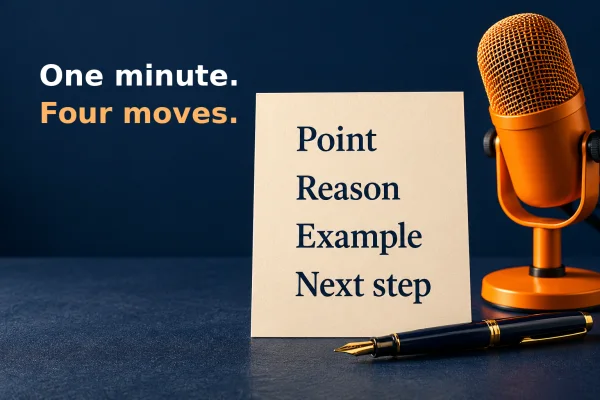
Build a one-minute talk around four simple moves
A short structure gives students somewhere to start. Use a topic they already understand, such as keeping classroom books organised, choosing a class activity or explaining an interesting object.
Point: What is the one idea you want the listener to remember?
Reason: Why do you think that idea is useful or reasonable?
Example: What observation, experience or clearly identified evidence makes it concrete?
Next step: What would you suggest, ask or conclude?
For example: “Our classroom should have a return tray for borrowed books. It would give everyone one place to look. Yesterday, I found a library book under a pile of worksheets. We could try the tray for a week and see whether it helps.” This is a fictional practice speech, not a report about a particular school.
The example is deliberately modest. One misplaced book does not prove that every classroom has the same problem. A good speaker describes what they actually know and keeps the conclusion proportionate.
Write four keywords on a small card rather than memorising a full script. The student can glance at “tray, easier, book, trial” and express the idea naturally. If they lose their place, pausing and returning to the next keyword is a useful skill in itself.
AI-generated educational illustration: four simple moves for a short talk.
Choose topics with room for a real discussion
A good beginner topic is familiar, specific and safe. “How could we make the classroom reading corner easier to use?” is easier to explore than “How should education change?” Narrow questions encourage students to offer workable ideas.
For Classes 6–7
Explain how to play a favourite game fairly
Recommend a book to someone with different interests
Describe one improvement to a shared classroom space
Teach a partner a simple process in the correct order
For Classes 8–10
Compare two ways of organising a school event
Discuss how a class could reduce wasted materials
Explain a local civic issue using an age-appropriate source
Consider the advantages and difficulties of a proposed school rule
These are suggestions, not age tests. A younger student may enjoy complex discussion; an older learner may need a simpler starting point. Avoid making classmates debate whether another person deserves dignity, inclusion or safety. No student should have to disclose a painful personal experience to make a speech interesting.
Listening is a skill you can practise separately
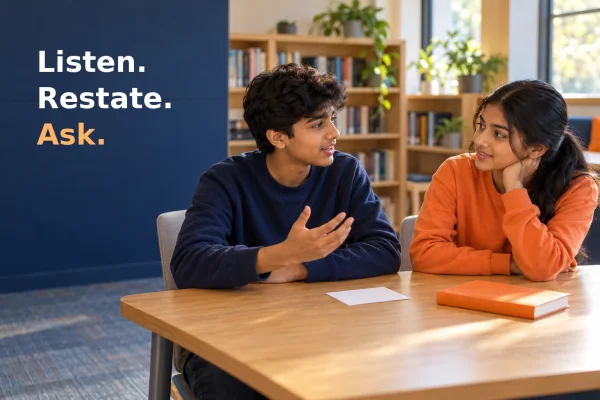
Students sometimes spend another person’s speaking time preparing their own reply. A small change helps: before responding, restate the other person’s main point and ask whether you understood it correctly.
Try a partner exercise. One learner explains a view for a short turn. The listener then says, “Your main reason is…” The speaker confirms or corrects the summary. Only then does the listener ask a question or add a different view. Swap roles afterwards.
Useful follow-up questions include:
What makes that example important?
Would the idea work for someone in a different situation?
What would we need to know before deciding?
Is there a smaller version we could try first?
The aim is to understand the idea accurately before evaluating it. Teachers can praise a careful summary just as visibly as an impressive speech, so that students notice listening is valued.
AI-generated educational illustration; fictional students demonstrate listening, restating and asking.
Disagree with a reason and leave room to change your mind
Respectful debate works best when the group agrees on a few rules before starting: one speaker at a time, no personal comments, fair speaking opportunities and a clear way to ask questions. A chairperson can keep the discussion on the proposal.
The UK Parliament’s secondary debating resource offers examples of structured classroom activities, planning and moderation. Its institutional setting is British; teachers in India should adapt activities to their own curriculum and classroom. The useful transferable idea is to make the discussion’s structure explicit.
Students can practise phrases such as “I see the benefit, but I’m concerned about…” or “That example changes part of my view.” These sentence starters help them move beyond agreement, disagreement and interruption.
Ask learners to describe one possible disadvantage of their own proposal. If they suggest a longer lunch break, what happens to the rest of the timetable? If they suggest more plants, who will water them during holidays? Considering a difficulty makes the proposal more thoughtful.
A discussion may end with a revised idea, an unanswered question or two reasonable options. Adults need not force a winner when the learning goal is understanding.
A hypothetical classroom example: planning a reading corner
Imagine a Class 8 group discussing a reading corner. This is an illustrative scenario, not a Junior IAS Academy student outcome or testimonial.
One learner wants new books. Another suggests rearranging the existing shelves. A third notices that some students cannot find books they enjoy. Initially, the group is arguing about solutions before agreeing on the problem.
The teacher asks each speaker to state their concern in one sentence. The students then separate three questions: Are enough books available? Can people find them? Do the choices match different interests?
Instead of voting immediately for the loudest proposal, they decide to inspect the shelves and invite voluntary suggestions. Each learner takes a different role: speaker, listener, note-taker or discussion chair. The group can revisit its proposal when it has more information.
The learning lies in the process: defining a question, explaining a reason, summarising another view and recognising what remains unknown. There is no invented claim about marks, confidence scores or future examination success.
Help a hesitant speaker choose the next manageable step
Some students are comfortable speaking to one friend and uncomfortable addressing the whole class. Plan a progression with them: a trusted adult, a partner, a small group, then a larger audience when appropriate.
Offer choices within the activity. A learner might begin by introducing an object, reading their own short paragraph, co-presenting with a partner or asking one prepared question. Give preparation time and explain the format in advance.
Avoid surprise performances, public comparisons and demands to “stop being shy.” If a student becomes distressed, reduce the pressure and talk privately about what support would help. Persistent communication difficulties or significant anxiety may call for advice from the school’s appropriate support staff or a qualified professional.
Students with disabilities or communication differences may use notes, assistive communication, an alternative format or extra processing time. Participation should be designed around access, not one ideal way of standing, looking or speaking.
AI-generated illustration: choose a manageable next step; this is not a student testimonial.
Keep language practice separate from judging ideas
A student may explain an excellent idea in Tamil, Hindi or another home language and still be developing the vocabulary to present it in English. Let them first work out the meaning in a language they know well, then build the words needed for the intended audience.
For bilingual practice, ask for a short explanation in the familiar language, identify three important terms together and rehearse a brief version in the target language. Translation need not be word for word if the meaning remains accurate.
Correcting every grammar slip during a first attempt can interrupt the student’s thinking. Agree on the purpose of the exercise: explaining a concept, practising a particular phrase or preparing a formal presentation. Feedback can then match that purpose.
Use a light weekly routine rather than daily pressure
A short practice session can fit around ordinary schoolwork. The following sequence is a flexible example, not a scientifically validated training schedule.
Choose: Pick one familiar question together
Plan: Write a point, reason, example and next step
Speak: Try the talk with a trusted listener
Listen: Summarise the listener’s question before answering
Reflect: Name one useful improvement for next time
Stop while the exercise still feels manageable. Families do not need to record or post the performance. If recording would help the learner, agree on it first, keep it private and follow school and family privacy expectations.
Choose feedback that describes something the student can change: “I understood your example; pause before the last sentence.” Avoid vague labels such as “born leader” or “weak speaker,” which say little about what to practise next.
Frequently asked questions
Does public speaking require fluent English?
No. Explaining ideas and listening can be practised in any language the learner uses. English presentation practice can be added when it serves the school task or the student’s goals.
Should students memorise speeches?
Memorisation may suit a particular performance, but everyday communication also needs flexibility. For practice, a short outline usually leaves more room to respond to questions and explain ideas in the student’s own words.
How can parents help without taking over?
Ask one genuine question, listen to the answer and offer one specific suggestion. Let the student choose their examples. Rewriting the entire speech may produce smoother wording while leaving them with less ownership.
Is debating useful only for competitive students?
No. A small discussion about a shared decision lets learners practise reasons, turn-taking and listening without a contest. Rotate roles so that students can contribute in more than one way.
How should progress be noticed?
Compare the learner with their earlier attempts. Look for a clearer main point, a more relevant example, a thoughtful question or greater willingness to participate. Progress can be uneven and need not become another public score.
Start with one worthwhile conversation
For school learners, the immediate value of speaking practice is being able to explain, ask, listen and take part. A useful first step today is simple: choose a familiar question, prepare four keywords and share the idea with a supportive listener.
Clear communication grows through many such opportunities, with room for different personalities, languages and learning needs.
A message appears in a class group: “All schools will be closed tomorrow.” It has a bold headline, an official-looking emblem and several forwards. Should you believe it?
Read the complete guide ↗
Critical thinking / Learning guide
Current Affairs for Students: How to Check Facts and Understand the News
Junior IAS Academy · 11 min read
Academy learning journal · Originally published on LinkedIn. The complete guide is available below without leaving this website.
A message appears in a class group: “All schools will be closed tomorrow.” It has a bold headline, an official-looking emblem and several forwards. Should you believe it?
Before deciding, you need more than the confidence of the person who shared it. Which schools? In which place? On what date? Who issued the information, and where can the original notice be found?
These questions are a useful starting point for current affairs. For students in Classes 6–10, understanding the news is about learning to investigate a claim, connect it with what you know and explain what the evidence supports.
The short answer: choose an age-appropriate story, identify its main claim, investigate who is behind it, check the supporting evidence and establish the date and context. Then write a short explanation that separates confirmed information from opinion and unanswered questions.
This Junior IAS Academy guide offers a practical approach for students, parents and teachers. The activities are original suggestions to adapt with adult guidance. They are not a promise of examination results or a requirement to follow every headline.
What should current affairs mean for a school student?
Current affairs includes developments in public life, science, the environment, culture, sport and other areas that affect people. A school student does not need to treat the news as an endless list of names and dates.
A better starting point is one understandable question. A report about a local water project might prompt: what problem is being addressed, and who is responsible for explaining the plan? A science story might prompt: what was observed, and what remains uncertain?
Choose stories that connect with the learner’s age, interests and school subjects. Teachers and parents can help select suitable material and explain unfamiliar background. Graphic or distressing content is not necessary for developing thoughtful reading habits.
For younger learners, begin with a short, adult-selected article and discuss it together. Older learners can take more responsibility for finding the original source and comparing accounts, while still asking for help when a topic becomes complex.
AI-generated educational illustration: students and a teacher examine a news report together. The people shown are not Academy testimonials.
Start by writing the claim in one sentence
A claim is something being asserted. Before checking it, make sure you know exactly what it says.
Imagine a fictional headline: “New library programme transforms reading across the city.” That sentence contains several possible claims. A programme may have started; it may operate in some libraries; the headline may also suggest an improvement in reading. Those are different questions to investigate.
Write the smallest clear statement first: “A new reading programme has started at these named libraries.” Then list the larger questions separately. What does “transforms” mean? Is there evidence about participation or learning? Does the report describe a plan, an early observation or a measured result?
This exercise keeps an exciting phrase from silently becoming a stronger conclusion than the article supports. It also gives the student a precise question to discuss with a teacher.
Investigate the source beyond its own page
A polished website can introduce an organisation, but its appearance does not establish its expertise or independence. Look beyond what an unfamiliar source says about itself.
The Digital Inquiry Group’s Civic Online Reasoning approach centres on investigating the people or organisations behind information, examining evidence and comparing what other sources report. One strategy is lateral reading: leaving the original page to learn about the source through other reliable information. Digital Inquiry Group: Civic Online Reasoning
With adult guidance, open a separate search and investigate the organisation’s role. Does it conduct the research, sell a related product, report on the subject or offer commentary? These roles can help explain a perspective, but none automatically proves a particular statement true or false.
For a school announcement, go to the school’s established communication channel. For a claim about a research finding, look for the original research or institution’s explanation. Ask whether the source is in a position to know the specific fact being checked.
What does the research suggest?
A 2023 study by Sarah McGrew and Joel Breakstone examined digital-literacy lessons integrated into ninth-grade biology and geography. Pre- and post-assessment data from 574 students showed improvement in evaluating online credibility. The lessons included explicit instruction and opportunities to practise evaluating sources. Read the study
This supports treating source evaluation as a skill to teach and practise. It does not establish that reading this article will produce the same outcome, or that the results apply identically to every Indian classroom. The study’s context and design matter when interpreting its findings.
For families, the practical takeaway is modest: show the checking process, let the student attempt it with support, and discuss the reasoning. Simply telling a child to “be careful online” leaves the method unexplained.
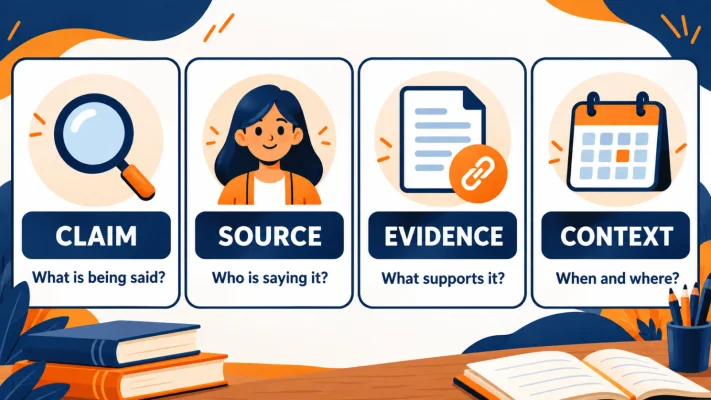
Four questions for a classroom discussion: what is claimed, who says it, what supports it, and when and where it applies.
Follow the evidence to what it actually shows
An article may link to a report, a notice, an interview or a dataset. Open the relevant source when it is suitable and accessible, and check whether it supports the statement you are investigating.
Consider a fictional report saying that a school collected 200 books for a library. A dated collection record might support the number collected. It would not, on its own, establish how many children read those books or whether their reading improved.
Ask students to draw two columns: “The evidence shows” and “The evidence does not yet show”. The purpose is not to dismiss useful information. It is to keep the conclusion close to what has actually been established.
When the source is too technical, ask a teacher to help identify the relevant section. Do not pretend to have verified a result merely because you found a document with a scientific title.
If the original evidence cannot be located, record that limit. “I have not verified this” is a useful statement of your current position.
Check the date, place and missing context
A real photograph or genuine notice can be misleading when attached to the wrong time or place. Begin with the publication date and, where relevant, the date of the event itself.
Return to the school-closure example. A notice might be authentic but apply to an earlier day, a particular district or only certain institutions. A screenshot may omit the section that defines its scope.
Ask the student to complete this sentence: “This information applies to ___, in ___, on ___.” If an important space remains blank, there is more to investigate before acting on or sharing the message.
Numbers need context too. “Participation doubled” is incomplete without the starting number, the period and what counts as participation. If a fictional club grows from five participants to ten, it has doubled; that does not mean it now includes most students in the school.
The arithmetic can be correct while an impression is exaggerated. Read both the number and the description around it.
Separate reporting, opinion and prediction
A single story may include several kinds of statements. A report that a meeting took place is different from a commentator’s view that the meeting was useful. A prediction about what will happen next is different again.
Try marking a short, teacher-selected passage with three labels: a factual statement that can be checked, an interpretation or opinion, and a prediction. Some sentences may require discussion before a label is appropriate.
An opinion can be thoughtful and well supported. The task is to recognise how the writer reached it and whether you find the reasoning persuasive. Disagreeing with an opinion does not automatically make the writer’s factual statements false.
Likewise, a prediction that later proves wrong should be assessed in light of how it was presented, what information was available and what uncertainty was acknowledged. Careful reading leaves room for these distinctions.
Repetition is not the same as independent confirmation
Three websites may repeat one press release. Several accounts may share the same screenshot. Counting those appearances does not tell you whether different people independently checked the claim.
When comparing reports, look for the origin of the information. Do they refer to the same announcement, or do they provide additional reporting or evidence? Explain the relationship in your notes instead of treating every repeated statement as a separate confirmation.
UNESCO’s media and information literacy resources encourage learners to examine false and misleading content and its effects. The broader aim is informed participation, not blanket distrust of all media. UNESCO: media and information literacy
A useful student habit is to ask, “What new information does this second source add?” Sometimes the answer is context. Sometimes it is a correction. Sometimes it adds nothing beyond repetition.
A strong current-affairs answer explains what is known, why it is credible and what remains uncertain.
Editorial takeaway from this Junior IAS Academy guide.
An illustrative classroom investigation
Consider a fictional Class 8 student, Kavya, who sees a post claiming that a public library will stop lending books. She is preparing a short classroom news discussion and initially writes, “The library is closing.”
With her teacher’s help, she finds the library’s original notice. In this invented example, lending is paused for a short stock-check period, while other services continue. She checks the dates and the library branch named in the notice.
Kavya revises her summary: “This branch has announced a temporary pause in lending during its stock check. The notice does not say that the library is permanently closing.” She includes the source, the relevant dates and one question about when normal lending resumes.
No examination score or programme result is claimed here. The example illustrates a change in reasoning: a broad interpretation becomes a narrower statement supported by the available evidence.
AI-generated illustration: a parent listens as a student explains her source and conclusion. The scene is fictional.
Build a useful current-affairs notebook
A notebook should help you explain a story, not become a collection of copied paragraphs. Try one page with these headings:
My question: What am I trying to understand?
The claim: What exactly is being asserted?
Source and date: Where did I find it, and when does it apply?
Evidence: What supports the claim?
My explanation: What can I say in my own words?
Still uncertain: What needs further checking?
School connection: Which concept from class helps me understand it?
For a geography story, the connection might involve a map or a resource. For civics, it might involve an institution’s role. For mathematics, it might involve a percentage or a comparison. Avoid forcing every story into every subject.
Keep the page short enough to discuss. One well-explained development can offer more learning than a long list the student cannot interpret.
How parents and teachers can support the habit
Model uncertainty openly. Say, “I do not know yet; let us find the original information,” when that is your actual position. This shows that checking is part of responsible thinking rather than an admission of failure.
Ask the learner to explain the route taken: which source was checked first, what changed their view and which question remains open. Praise a well-supported correction instead of rewarding only a quick answer.
Use age-appropriate material and respect a child’s reaction to upsetting news. A student can learn source-checking with a library notice, a sports report or a science announcement. There is no need to seek disturbing content for practice.
Avoid asking children to confront strangers online or publish personal details as part of a checking exercise. An adult-guided discussion and private notes are enough. Follow the school’s digital-safety guidance and the rules of any tools being used.
Frequently asked questions
How can students start reading current affairs?
Begin with one suitable story selected with a teacher or parent. Identify the main claim, read the full account, clarify unfamiliar words and investigate the source before writing a short explanation.
Is memorising headlines enough?
A headline is a starting point. Understanding also requires the event’s context, the evidence behind the account and the ability to explain what it means without adding unsupported conclusions.
Should students believe an AI-generated news summary?
Treat it as a starting point for questions, not as independent proof. Open and check any cited sources. If a citation cannot be located or does not support the statement, leave the claim unverified. Follow school guidance on age-appropriate AI use.
What if reliable reports disagree?
Compare the date, scope, evidence and kind of statement being made. The reports may describe different stages or include different interpretations. Ask a teacher for help and explain the disagreement instead of forcing a confident answer.
Does this require an adult competitive-exam timetable?
No. For Classes 6–10, the activity can support curiosity, reading and civic understanding alongside normal school learning. This guide does not prescribe a study duration or promise future examination selection.
Start with one story and a better question
Choose a manageable news item this week. Write its main claim, trace the source and explain the evidence in your own words. End with one question that you would like to investigate further.
For students and families in the Junior IAS Academy community, thoughtful current-affairs reading can begin there: curiosity supported by evidence, respectful discussion and the confidence to say when something is not yet known.
Research note: The linked sources support the source-evaluation principles and research discussion. The classroom examples, notebook structure and family activities are original illustrations, not evaluated claims about Junior IAS Academy’s programme or students.
“I understood it yesterday. Why can’t I explain it today?”
Read the complete guide ↗
Study skills / Learning guide
How to Study and Remember What You Learn: A Research-Informed Guide for Classes 6–10
Junior IAS Academy · 10 min read
Academy learning journal · Originally published on LinkedIn. The complete guide is available below without leaving this website.
“I understood it yesterday. Why can’t I explain it today?”
Many students recognise this feeling. The page looked familiar, the example made sense, and the chapter seemed finished. Then a question appeared without the textbook beside it, and the answer was harder to find.
That moment is useful information. It tells us that reading a lesson and being able to use it independently are different tasks. A good study routine makes room for both.
This guide from Junior IAS Academy is for students in Classes 6–10 and the parents and teachers who support them. It explains a few well-researched learning ideas and turns them into practical activities for science, mathematics, social science and reading. The sample routines are suggestions to adapt, not a prescription for every child.
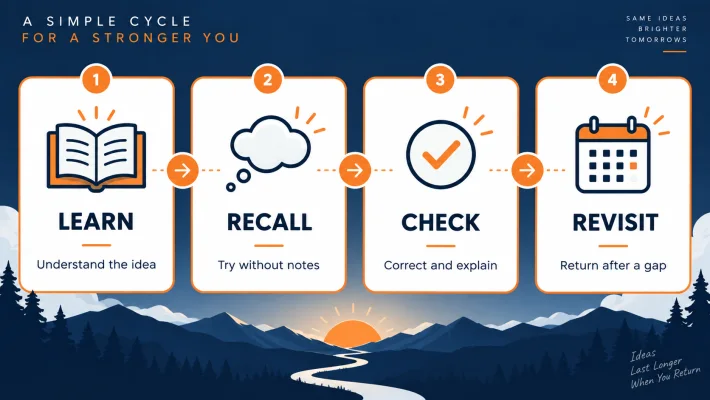
The central idea: Learn with understanding, try to recall without looking, check what needs correcting, and return to the topic after a gap.
AI-generated illustration: a student attempts an explanation before checking her notes.
What does research actually tell us?
Retrieval practice means trying to bring previously learned information to mind. It might involve explaining a concept, sketching a diagram or answering a question before opening the notes. It is a learning activity, not necessarily a graded test.
A 2021 systematic review by Pooja Agarwal, Ludmila Nunes and Janell Blunt examined 50 classroom experiments involving 5,374 learners. It reported benefits across different educational settings, but also noted that only 6% of the experiments came from countries outside the commonly studied Western, educated, industrialised, rich and democratic contexts. That is a reason to apply the evidence thoughtfully, rather than promise identical results in every Indian classroom. Read the research abstract.
Research also needs a fair comparison. A separate classroom review found the advantage of retrieval was less consistent when compared with some other active learning activities than when compared with simply restudying or doing nothing. The practical message is to combine recall with explanation, instruction and meaningful practice—not turn every lesson into a quiz. Moreira and colleagues, 2019.
Begin with a question you can answer
“Study geography” is difficult to act on. “Explain how a river carries and deposits material” gives the session a purpose. Before opening the book, write one question that matches what your teacher expects you to understand.
Read a manageable section, examine the diagram and clarify unfamiliar words. If the explanation still does not make sense, ask for help. Trying to recall material that has never been understood is unlikely to solve the underlying difficulty.
Here are some starting questions you can adapt to your current syllabus:
Science: What changes during evaporation, and what stays the same?
Mathematics: Why is each step in this equation valid?
Social science: What problem was this institution created to address?
English: Which detail in the passage supports my interpretation?
The question should be small enough to attempt and important enough to discuss. A page count alone does not tell you what you have learned.
Close the book and make your thinking visible
After studying, put the material aside briefly. Write what you remember, answer your starting question aloud, or draw the process from memory. Use ordinary language first; then add the precise subject vocabulary.
For a science process, a rough diagram with explained arrows is more useful than an attractive drawing whose connections you cannot describe. For history, try a short sequence that connects an event, its causes and its consequences. For vocabulary, use the word in a sentence of your own.
Keep this attempt private or low-pressure. The aim is to find the parts that need attention. You do not need a score for every practice activity.
If nothing comes to mind, make the task smaller. Look at one heading, use a teacher-provided cue, or return to an explanation. A blank page is a signal to adjust support, not a reason to label yourself a poor learner.
Checking is a separate step
Open the textbook or a reliable teacher-provided answer after your attempt. Compare carefully. Mark what was accurate, what was missing and what was misunderstood.
Do more than copy a correct sentence over an incorrect one. Write a short explanation of the correction: “I described the result, but I did not explain the cause,” or “I used the right formula but substituted the wrong quantity.” This makes the next practice attempt more purposeful.
The Australian Education Research Organisation recommends retrieval opportunities that include all students and the use of feedback to address gaps. Its guide also stresses selecting tasks appropriate to what students have learned. AERO spacing and retrieval practice guide.
For your own notebook, three headings are enough: My attempt / What needs changing / What I will try next. You can complete a useful entry in a few lines.
Learning cycle: understand, recall, check and revisit. AI-generated educational graphic.
Return to important ideas after a gap
Spacing means revisiting learning across separate occasions. Instead of treating a completed chapter as permanently finished, bring selected ideas back into later sessions.
The US Institute of Education Sciences recommends spreading learning over time, using quizzes to revisit key content, and asking explanatory questions. These are teaching and study principles, not a claim that one fixed timetable suits everyone. IES practice guide.
For example, after studying a topic on Monday, you might attempt a few questions on Wednesday and explain the main idea again over the weekend. If you can answer comfortably, include a more demanding application next time. If the explanation has become confused, revisit the relevant section sooner.
Treat that timetable as an example. The right gap depends on the topic, your current understanding and when you need to use the knowledge. A guide by cognitive scientists Shana Carpenter and Pooja Agarwal explains why recall across spaced sessions, followed by checking, can support durable learning. Spaced retrieval guide.
Adapt the routine to the subject
In mathematics, explain the method as well as the answer. Start with a worked example from your teacher. Cover it and attempt a similar question. When checking, locate the first step where your reasoning differs. Later, try a question where you must decide which method to use, rather than being told in advance.
In science, connect words, diagrams and observations. After learning a process, draw a simple version from memory and explain what each arrow means. Then consider an everyday example. If the explanation changes between the diagram and your spoken answer, investigate that difference.
In social science, connect facts with relationships. Knowing a term is a starting point. Ask what it means, why it matters and how it connects to the topic. Make a small comparison between two ideas that are easy to confuse. Check the comparison against your textbook.
In reading, support your answer with the text. Read a short passage, summarise its main point, then reopen it to find the details that support your summary. Distinguish what the writer states from what you infer. An interesting opinion still needs a reason.
These are original classroom-style activities for this guide. They are not a substitute for your teacher’s subject-specific instructions or assessment criteria.
Learn to notice how you are learning
The word metacognition describes thinking about and managing your own learning. In practice, it can be as simple as deciding how to approach a task, noticing when the approach is not working, and reviewing what helped.
The Education Endowment Foundation advises teaching these strategies explicitly within real subject lessons. Students benefit from seeing teachers model how they plan, monitor and evaluate a task; simply telling children to “think harder” is not enough. EEF guidance.
Try a short reflection after a study session:
What was I trying to understand?
What could I explain without help?
Where did I need a hint or an example?
What is the next useful question?
Be specific. “I am bad at science” closes the conversation. “I can name the stages, but I cannot explain why this stage happens” gives you and your teacher a workable starting point.
AI-generated illustration: students explain ideas and discuss questions with teacher support.
A sample week: one topic, several kinds of thinking
Consider a fictional Class 8 student, Meera, working on a school lesson about local government. This example illustrates a routine; it is not an Academy student testimonial or a measured intervention.
Monday: Meera reads the assigned section and writes two questions about responsibilities and decision-making. She checks the meaning of unfamiliar terms with her teacher’s notes.
Wednesday: Without looking, she explains one responsibility in her own words. Her explanation confuses two levels of government. She checks the text and writes a corrected comparison.
Friday: She discusses a simple community issue with a classmate: a public space needs maintenance. They identify what they know, what they are assuming, and which details they would need to verify before assigning responsibility.
Sunday: She revisits the original questions and writes a short answer with an example. She notes one remaining doubt for class.
The useful outcome in this example is a clearer record of her thinking. No score increase is invented. She has moved from recognising a paragraph to explaining an idea, finding an error and applying a distinction.
How parents can help without taking over
Ask your child to show one idea they can now explain and one question they still have. Listen before correcting. If the answer is unclear, invite them to use the book to investigate it with you.
Useful prompts include: “What makes you think that?”, “Can you show me an example?” and “Which part should we ask the teacher about?” Avoid turning every conversation into a rapid-fire quiz or comparing the child with a sibling.
Agree on a manageable place and time for study. Keep space for play, interests and rest. If the routine repeatedly causes frustration, reduce the amount, adjust the format and speak with the teacher about suitable support. Some students may explain more clearly aloud, through a diagram or with a prompt before they are ready to write independently.
The adult’s role is to support growing independence, not produce perfect answers on the child’s behalf.
Frequently asked questions
Is rereading a waste of time?
No. Reading helps you encounter and clarify material. Add an attempt to explain or use it, followed by checking, so your routine also reveals what you can do independently.
Does retrieval practice mean memorising everything word for word?
No. Questions can require explanation, comparison and application. Some precise terms need accurate recall, but understanding also involves relationships and reasons.
How long should a student study each day?
There is no single duration established by this article. School demands, age, task difficulty and individual needs vary. Begin with a manageable task and review whether the time produced useful learning.
Can these habits help future competitive-exam preparation?
They can support knowledge-building and independent study. They do not guarantee selection or mean that a school child needs an adult exam timetable. At this stage, strong school understanding and curiosity are worthwhile goals in themselves.
Start with one lesson
Tonight, choose a small topic you have already been taught. Ask one question, explain the answer without looking, check it, and decide when to return. Keep the correction as carefully as the answer.
For students, families and educators in the Junior IAS Academy community, that is a practical starting point: make learning visible, discuss uncertainty openly, and build a routine that becomes more independent over time.
Research note: The linked sources explain the evidence behind the learning principles. The subject activities, sample schedule and fictional example are original illustrations, not tested claims about this Academy’s programme or results.
Continue exploring
From the learning desk to the printed page.
Our original Tamil features and press clippings remain in the collection below.
FEATURE 01
Tamil / Education
Learning & educational guidance
Read the original Tamil educational feature across three pages.
FEATURE 02
Tamil / Kungumam
A mentoring journey in Tamil media
Explore the original four-page Tamil magazine feature.
FEATURE 03
Tamil / Press profile
A journey of perseverance
Original press coverage of Reshmi’s personal and mentoring journey.
FEATURE 04
Tamil / Newspaper
Civil services mentoring in print
A newspaper feature preserved as its original published clipping.
FEATURE 05
Recognition / Educator
AIWAA educator recognition
Read the supplied article about educator recognition.
Articles retain their original language and layout. Descriptive card headings are navigation labels, not transcribed publication headlines.
Practical learning guides for students and families
Start with a guide that answers a question you have today. Learn how to check a news claim, practise a short talk, read a map, interpret percentages or remember what you study.
 Citizenship & Awareness
 Junior IAS Academy